
Internal vs External Hiring: The Hidden Costs of Executive Recruitment

Internal vs External Hiring: The Hidden Costs of Executive Recruitment

You’ve completed your succession planning exercises, carefully segmenting talent into “ready now” and “wait 1-3 years” categories. But what happens when a critical leadership position opens and no one in your succession plan is immediately ready?

The knee-jerk reaction? Look outside for executive talent. After all, 70% of leadership positions are filled externally. But this conventional approach may be costing your organization millions in hidden expenses and missed opportunities.

The True Cost of External Executive Hires

Direct Financial Impact

External executive recruitment carries significant costs that extend far beyond the initial search:

  • Search costs: $100,000+ for executive search firms
  • Salary premium: 20% higher compensation than internal promotions
  • Time investment: 6 months average to complete the search process
  • Onboarding lag: 6-9 months before new executives make significant contributions

According to Egon Zehnder research, 57% of externally hired leaders report minimal impact in their first six months, with 20% taking up to nine months to contribute meaningfully.

The 50% Failure Rate Reality

Here’s the sobering truth: external executive hires fail 50% of the time within the first 18 months. This risk increases dramatically when the external candidate is being promoted into a more senior role than they’ve previously held.
Hard costs of a failed executive hire include:

  • Initial search fees
  • Second recruitment process
  • Compensation and benefits during employment
  • Severance packages
  • Total hard costs: Approximately 3x annual salary

Soft costs compound the problem:

  • Talent departures triggered by the failed hire
  • Lost business from management style misalignment
  • Management time spent on two searches
  • Legal costs and termination due diligence
  • Cultural disruption and team morale impact
  • Total soft costs: Up to 10x annual salary

Bottom line: A failed $300,000 executive hire can cost your organization up to $3 million.

Gender Equity Considerations

When external male candidates are hired over qualified internal female candidates, organizations face potential gender equity issues that carry both legal and cultural ramifications.

The Internal Promotion Advantage

Lower Risk, Higher Returns

Promoting internal candidates who aren’t quite “ready” offers compelling advantages:

Cultural alignment:

Internal candidates already understand your formal and informal processes, reducing cultural misalignment risk significantly.

Existing relationships:

Established connections with customers, stakeholders, team members, and leadership accelerate effectiveness.

Industry knowledge:

Deep familiarity with your specific market, competitive landscape, and operational challenges.

No search costs:

Eliminates $100,000+ in recruitment fees.
H4-Retention benefits: In today’s competitive talent market, failing to promote internal candidates signals limited growth opportunities, pushing ambitious employees toward competitors.

The Time-to-Impact Comparison

The critical question isn’t “Is the internal candidate ready today?” but rather “Where will they be in 6-12 months with proper coaching?”
H4-Internal promotion timeline:

  • Month 1-3: Steep learning curve with targeted coaching
  • Month 4-6: Competency development and increasing impact
  • Month 8: Meeting performance expectations
  • Month 9+: Leveraging organizational knowledge for accelerated growth

External hire timeline:

  • Month 0-6: Position remains vacant during search
  • Month 6-9: New hire learning organizational culture and processes
  • Month 9-12: Beginning to make meaningful impact
  • Month 12-18: 50% chance of failure or 50% chance of success

By the time an external hire begins contributing meaningfully, a coached internal candidate often reaches equivalent performance levels—with substantially lower risk.

The Coaching Investment

Rather than accepting the “not ready” label as final, invest in targeted executive coaching during the 6-9 months you’d otherwise spend searching for and onboarding an external candidate.

Coaching focus areas:

  • Strategic thinking and decision-making
  • Stakeholder management
  • Leadership presence and communication
  • Change management capabilities
  • Industry-specific expertise gaps

This investment typically costs a fraction of external search fees while building long-term organizational capability.
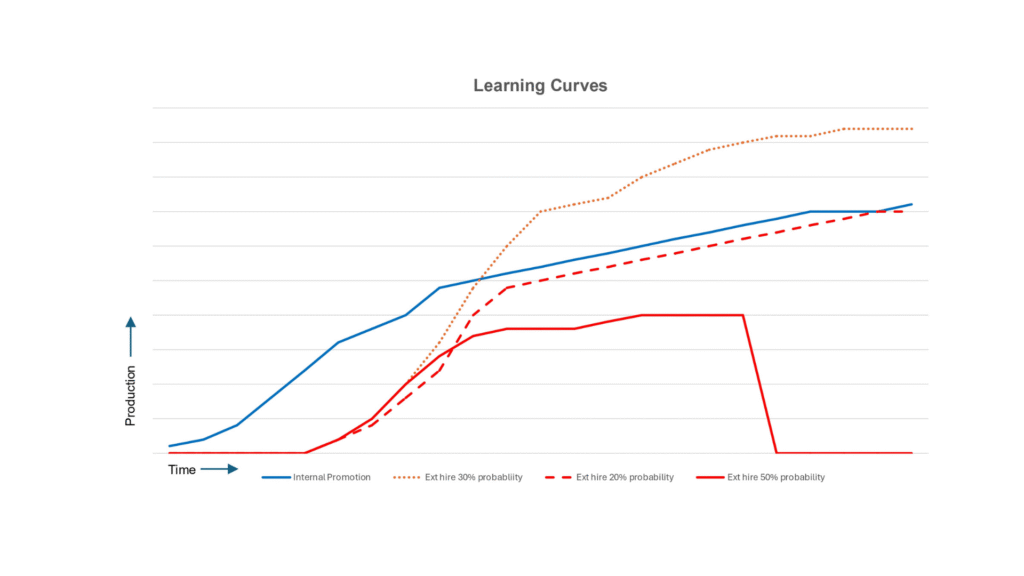
Internal promotion v external hires

When External Hiring Makes Sense

Despite the advantages of internal promotion, external recruitment is sometimes the right strategic choice:

1. No Viable Internal Candidates

When internal candidates cannot reasonably reach adequate performance levels even with extensive coaching, external hiring becomes necessary. However, this should trigger immediate action to strengthen your leadership pipeline. Action items:
  • Implement structured leadership development programs
  • Create stretch assignments for high-potential employees
  • Establish formal mentorship relationships
  • Invest in executive education opportunities

2. Need for Fresh Perspective

Certain situations benefit from external viewpoints:
  • Industry disruption requiring new approaches
  • Organizational turnaround scenarios
  • Diversity of thought and experience gaps
  • Strategic pivots demanding different expertise
Best practice: Pair external hires with internal leaders who provide institutional knowledge, enabling smooth strategy implementation.

3. Known, Proven External Candidate

When a specific external candidate brings proven success, existing relationships with current leadership, and direct experience in the vacant role, accelerated impact becomes realistic.

Common scenario: New CEOs bringing trusted former colleagues who can implement their vision quickly.

Caution: Avoid overwhelming your culture with too many external hires from a single organization. A C-suite dominated by former employees from one company rarely replicates that company’s success and often destroys your organization’s unique identity.

4. Cultural Consistency with External Benchmarking

Some organizations have cultures built on external competition and market testing across all functions—products, processes, and talent.

If your business units routinely evaluate external vendors against internal capabilities, applying the same rigor to talent decisions maintains cultural consistency.

Approach: Even with identified internal successors, conduct external searches when this aligns with organizational values. If external candidates prove superior, hire them while staying true to your principles.

Best Practice: The Interim Title Strategy

When asking an internal employee to fill a leadership role during evaluation or search periods, assign an interim title.

Why this matters:

Acknowledges contribution: Reflects the actual level of work being performed.

Signals consideration: Makes clear the employee is under serious consideration for permanent placement.

Enhances marketability: Provides resume credentials that increase both internal and external opportunities.

Builds trust: Demonstrates organizational confidence in the employee’s capabilities.

Outcome scenarios:
  • If promoted: Natural transition with minimal disruption
  • If not selected: Clear communication that someone more qualified was chosen, with interim title remaining on their resume
Retention insight: Enhanced external marketability doesn’t increase flight risk—it expresses trust and value, which typically strengthens retention.

Executive Succession Planning Framework

Assessment Questions

Before defaulting to external recruitment, ask:
  • 1. Can internal candidates reach adequate performance within 12 months with coaching?
  • 2. What organizational knowledge would be lost with an external hire?
  • 3. How will passing over internal candidates affect retention and culture?
  • 4. What is the total cost comparison including risk-adjusted failure costs?
  • 5. Does the situation truly require external perspective, or do we have untapped internal potential?

Decision Matrix Choose internal promotion when:

  • Candidates can reach competency within 12 months
  • Cultural fit and organizational knowledge are critical
  • Retention of high-potential talent is a priority
  • Budget constraints limit risk tolerance
Choose external hiring when:
  • No internal candidates show reasonable potential
  • A fresh perspective is strategically essential
  • A proven external candidate with relevant experience is available
  • External benchmarking aligns with organizational culture

Measuring Success in Executive Succession

Track these metrics to evaluate your succession planning effectiveness:
  • Internal promotion rate for leadership positions
  • Time-to-productivity for internal vs external hires
  • 18-month retention rates by hire source
  • Total cost per hire, including search, compensation, and failure costs
  • Employee engagement scores related to growth opportunities
  • Leadership pipeline strength at each organizational level

Conclusion: Reframing “Ready”

The conventional succession planning framework of “ready now” versus “needs development” creates a false binary that pushes organizations toward expensive, risky external hires.

A more sophisticated approach asks, “Can this internal candidate reach effective performance within the timeframe an external hire would need to make a meaningful impact?” Or simply considering “ready if” developmental milestones are accomplished.

When the answer is yes, internal promotion with targeted coaching offers lower risk, lower cost, and stronger cultural alignment—while simultaneously strengthening your employer brand and leadership pipeline.

The $3 million question isn’t whether your internal candidate is ready today. It’s whether you’re ready to invest in developing them for tomorrow.

FREQUENTLY ASKED QUESTIONS

C-Suite Coaching is personalized mentorship designed specifically for senior executives, helping them enhance leadership skills, navigate complex business challenges, and maximize their impact within the organization.

We carefully assess each executive’s role, industry, and development needs, then pair them with a mentor from our network who has relevant experience and insight to provide tailored guidance.

Executives engage in confidential one-on-one sessions, usually bi-monthly, where they explore challenges, set goals, and receive actionable feedback. Mentors remain accessible for urgent support between sessions.

We use regular progress reviews and feedback from both executives and their organizations to track growth, adjust plans, and ensure coaching delivers meaningful leadership and business outcomes.

5 keys to successful onboarding

MN Crossroads Career Services leader Harry Urschel hosts his July 18, 2024 webinar featuring Executive Springboard president, Steve Moss. Harry introduces Steve at the 16:33 mark.

Meet The New Boss

It’s always a challenge to get your footing when you are in a new job. It can be just as difficult when your job changes because a new boss is redefining your role.

An executive may easily be out of sync with their new CEO. Performance that once met expectations is no longer adequate. The new boss is unclear about their agenda and whether this executive fit in. There is a new relationship to forge. There is a new culture being built out of unspoken rules. The CEO might bring with them people who have worked with them before. Nobody knows whether this is the first step in a full housecleaning or not.

Sometimes, a new CEO has their own plan in mind, and it won’t include the leadership team that’s still in place from the previous regime. More often, a new CEO will recognize that there is benefit derived from having people who know how things work in an organization and can help to advance an agenda for change. The following seven suggestions are steps to take early in this new relationship.

Don’t take criticism of how things previously were done personally. A boss’s undiplomatic assessment of past strategy is not a reflection on your competence. Calling the previous plan stupid does not imply that they mean YOU are stupid.

Commit to the new boss’s success. A new boss brings with them a new direction. You may have been a critical part of the old direction. That doesn’t preclude you from being part of a new direction. You must decide whether you are wedded to a strategy that is about to change or whether you can buy into a new strategy. If you can’t be part of the change, leave. Resistance is futile and self-destructive. An early conversation should center around the boss’s vision and priorities, and how you can contribute to their activation. Context is important, but make sure your explanation of potential obstacles is not perceived as opposition to the new direction.

Seek clarity in your role in delivering change. The answer to “how can I help” may seem too obvious to ask. Ask anyway. It shows that you are on board. And it might also lead to surprising answers.

Clarify your decision rights. Executive Springboard calls these “Do-Tell-Ask.” What are the things you can do without informing the boss? What do they want to kept in the loop on, once you’ve acted? When do you need their permission to act? It may be hard to get granular on this, but you can establish a language that helps de-escalate potential conflicts: “I’m sorry, I thought this was a “tell,” and you see this as an “ask.”

Understand the boss’s communication preferences. Some have an open-door policy. Some have no meetings longer than 30 minutes. They may frequently reach out to your subordinates without including you. They may send out weekly voicemail messages to all staff. Most people can articulate their communications style better than they can define their leadership style.

Avoid trying to impress, whine or petition. It’s not about you; it’s about your boss. If you want to stand out, try not bringing your own agenda to the forefront. Instead, limit status reporting to 5 minutes, share successes, seek to understand their direction and engage in two-way feedback early on, if invited to do so. In other words, be a grownup. Ask for direction when you are lost or when your decision rights discussion says it’s needed. Besides that, do your job and let your boss do theirs.

Build a personal relationship incrementally. Ask them to lunch early on. Be aware that they are experiencing more disruption than you are. They are counting on you. Your authenticity is the quickest path to developing trust.

    Need Any Help?