Postcard from Florida: Killer Seafood

Postcard from Florida Killer Seafood 3

Driving north to Mexico Beach, Florida, you leave the Eastern time zone and enter the Central. For years, people would celebrate their second New Year’s here, as the clock struck midnight CST. It was a collection of well-worn beach cottages and motels on Gulf’s Forgotten Coast.

Mexico Beach is also the home of Killer Seafood, a dive of a restaurant with a blue awning, serving up fabulous grilled tuna tacos and bread bowls of shrimp and scallops in a homemade simmering sauce. My wife Margaret and I would drive about 45 minutes for lunch a couple times during our stay in Florida. We’d go to the ATM next door to get cash, since they didn’t take plastic. Killer deserved its listing in Coastal Living as one of the “Best Seafood Dives in America.”

Postcard from Florida Killer Seafood 1
Postcard from Florida Killer Seafood 2

In October 2018, Hurricane Michael made landfall at Mexico Beach as a Category 5 storm. We visited over three months later. Killer Seafood was gone. Toucans, a restaurant/tiki bar on the beach, was gone. Every landmark I knew was gone, replaced by piles of rubble. I felt bad being a disaster tourist, gawking at where a community once stood, unable to get my bearings. But it seared into my mind exactly how much had been taken away.

Postcard from Florida Killer Seafood
Last year, we spent January and February in a place that had as many FEMA people and contractors as snowbirds. There were piles of trashed appliances and insulation and siding at frequent intervals on roadsides. There were swathes of pine trees snapped ten feet above the ground, extending 30 miles inland. On Cape San Blas, where we stay, blue tarps covered most roofs. Some property owners had jumped into their restoration projects. Some had to bulldoze their structures and start afresh. Others, knowing that insurance would cover lost revenue for the next season, were not in a hurry to do anything.

There was another force of nature named Michael in Mexico Beach. This one is Michael Scoggins, who along with his partner Kevin Crouse, owns Killer Seafood. What we didn’t see last year, amid the rubble, were the first sprouts of rebirth in Mexico Beach. Just a week after Michael the Hurricane hit, Killer Seafood’s next incarnation was as a tented kitchen called Camp Happy Tummies, feeding first responders, those involved in the clean-up and residents who had no other place to go.

When we came back this year, there are obvious signs of regeneration throughout the area. The snapped pines had been cut down. In some places, the forest has become savannah. In others, a new generation of pines are beginning. The roads are fixed up. The rubble is gone. The roof repairs continue, although the army of contractors is much reduced.

We made the drive to Mexico Beach, hoping to see progress but not expecting any. Amid the now-vacant lots, we saw a blue trailer… the next phase for Killer Seafood. No bar. No dollar bills taped to the walls. No SEC basketball on TV. But the familiar blue color in a temporary trailer with a few picnic tables in front. With the old sailor statue that stood watch on the famous dive has been recovered and returned. With plans to rebuild. And with jars of simmering sauce being sold again all along the coast.
Postcard from Florida Killer Seafood 1 2
This is a short story of resilience. It’s not as simple as picking yourself up and dusting yourself off after taking a hit. The hits just keep coming and the path to daylight is full of twists and turns. Whether it’s fighting with your insurance company. Or realizing that it will be years before your town is viable again. Or running out of cash. Or getting over the depression of losing everything of personal value to restart your business.

Those who demonstrate resilience will say it’s the only alternative they had. They are wrong. They had the option of staying curled up on a ball. Of waiting for something good to happen, instead of making something good happen. For Killer Seafood, the funky charm that was within its four walls was wiped away. Or as Kevin Crouse said, “We had an interruption, and it’s taken a journey to get back where we are today.”

Not everybody looks at a Category 5 hurricane as “an interruption.” Not everybody gets back in the game, knowing it may not be what they had before, but it’s good enough for now. And not everybody makes a simmering sauce as good as Michael, Kevin and their team do. Kevin and Michael don’t know me from Adam. But I think their story is worth sharing. And so is their simmering sauce. Here’s a link to the Killer Seafood website, with information on where you can get this amazing stuff. http://www.killerseafood.net/PAGE_TWO.html

Postcard from Florida Loggerheads 2

​One of the first signs I encountered when driving onto Cape San Blas cautioned about the turtle nesting season. Visitors and residents are asked to keep their lights off on the beach from May to September to protect turtle nesting areas.

Since the era of dinosaurs, female loggerhead turtles have left the Gulf of Mexico, pulled themselves up on the beach above the high-water line and start digging. They dig about a foot and a half deep into the sand. They deposit over 100 golf-ball sized eggs and gently cover them up. Exhausted, they make their way back to the sea, never to see their brood again. But they are not done laying eggs, creating 3-5 clutches (and 35 pounds) of eggs between May and September (NOAA).

The eggs take 45-55 days to incubate. Less than 10% will hatch (takepart.com). The others will be dug up by hungry racoons, crabs and gulls, or by unthinking humans. Once hatched, it might take the turtles a week to dig their way to the sand’s surface.

At nighttime, in an activity that looks like a pot of boiling water, hatchlings emerge from the sand in unison. Once hatched, the turtles scoot down the slope of the beach, using the greater light intensity from reflections of the moon and stars on the water of the Gulf as a beacon.

Research by Erb & Wyneken at Florida Atlantic University in 2016 found that 8% of the hatchlings never make it the short distance to the water. They run into a gauntlet of mammals and birds, who may be overwhelmed by the large number of “turtle boil” hatchlings dashing for the surf en masse. Other hatchlings get turned around, confused by light pollution from beach houses, curious beachcombers or nearby urban areas. The baby Loggerheads dive into a wave and ride the undertow out to sea.

After entering the Gulf, the tiny Loggerheads are seldom seen for the next few years. Most experts agree they spend their first few years out in the ocean, riding currents, hiding in seaweed where they can find food. The hazards remain great. The turtles are dinner for predators and mistakenly ingest plastics and other man-made substances that can prove fatal. A few years ago, when a polar vortex extended as far south as the Florida Panhandle, turtles were stunned by the cold in St Joseph Bay. Volunteers saved hundreds of loggerheads, green turtles and Ridleys, and then released them into the Gulf once temperatures rose. All told, the odds that a turtle that makes it to the see will survive to sexual maturity are estimated at less than 1 in 1000.

While the numbers don’t look the same for executives in their business careers, the pattern is similar. There is a job selection process that is probably crueler than natural selection, with one candidate making it out of a couple hundred who applied or were considered.

A small number might be rejected in the assessment or reference check phase. Having cleared the terrestrial predators, it’s off to sea for the new hire, where a new set of threats await.

Our corporate hatchling faces an organization that might be passive-aggressive or downright opposed to the change the executive represents. They are invariably compared to the person they’ve replaced. They need to avoid destructive territorial conflicts with colleagues more adept at the local rules of engagement. They need allies; unlike the turtles that find safety in numbers, the employee is generally all alone. And they have a job to do.

We humans have some significant advantages over sea turtles when it comes to our survival. A reptilian approach is based on starting off with large numbers to overcome daunting odds. Mammals, and humans in particular, don’t start out with hundreds of siblings; instead, we’ve found ways of increasing the odds of survival in our favor. We have mothers. We have teachers. We develop friendships and communities that are generally based on more than just mating. We are nurtured. We find affiliation. We have social mechanisms that improve our effectiveness.

So, why does Homo Sapiens run into trouble when becoming Homo Newemployee? Because the same social mechanisms in organizations that improve our effectiveness are selectively permeable. Sometimes you’re let in. Other times, you remain an outsider. Or, going back to our sea turtle analogy, the workplace can be a harsh environment, especially when you are on your own, when there is no sargasso to hide behind, no mother to support you.

Organizations need to improve the chances that their new hires will succeed. They must create a process that assimilates new executives rather than leaving them to dive under a wave, ride the undertow and hope instinct and favorable currents will suffice. They can provide coaching and mentoring resources that help avoid mistakes. And they can attempt to create a culture that is open to the contributions of newcomers, instead of picking them off on the beach.

Upending assumptions

Tomorrow, I will meet my half-sister, Gabrielle, for the first time. I’ve mentioned this to a few dozen people over the two months that we’ve known about each other. I thought I would share it with about 6000 of my closest friends via this blog.

Our father passed away four years ago. He was not part of Gabrielle’s life, and he never told me about her. My sister grew up as the only child to a single mother. All she knew about her father was a misspelled name on a birth certificate. She took a DNA test and, voila, instant family!

I have to admit to a bit of shock when I learned I had a sister. Like tectonic plates shifting under my feet! I expected that it would take time to get used to not being an only child, at 63 years of age. But the shock lasted for only an hour or two. My next thoughts were about the hole Gabrielle had in her life that I could help fill. At the very least, I could help with family medical history. Having taken a DNA test, maybe she would be interested in the history of a family she did not know. Maybe a deeper relationship would blossom, as I hope and believe we are in the process of developing.

If you will allow me to move off of my personal human-interest story, I’d like to bring this experience to the kind of topic I usually cover. There are surprises in life and in business. Things don’t always go as you expect. And that can be a very good thing. But we have to be open to changing our preconceptions.

Imagine, after a successful twenty-year career with a Fortune 500 company, you are recruited by a $200M company to become its SVP of Operations. You have the accumulated knowledge of a world class organization that dazzles your new CEO and colleagues. You learned to take care of yourself in the rough-and-tumble politics of a big company. And you’ve built a reputation as a great leader with your previous employer.

Now you take stock of the new situation. The consistently excellent quality of the Fortune 500 workforce is far lumpier here. The systems in place are rudimentary. You worry that the “good enough” processes you want to enact might even be a bridge too far. And you sense that the collegial reception people gave you for the past twenty years has been replaced with a reserve that feels almost like folks are intimidated.

The history of experiences, the way you work because it has served you well, is sometimes called “employment baggage.” Leadership consultant Jeff Nischwitz put it this way: “Basically, employment baggage is what every employee brings to their new employment, new employer and new business relationships. This employment baggage is based upon all of the employee’s prior experiences (personal and observed), life experiences and even cultural messages.”

Just as we have emotional baggage, we have employment baggage. We expect that what worked for us in the past, is going to work in a new setting. Here’s the surprise: You are not working according to immutable laws of physics. What worked one place is not guaranteed to work in another. Put another way, we have to be aware of what our assumptions are and what factors in a new environment will support or refute those assumptions. We have to be ready to jettison some or all of our assumptions, to unload our employment baggage.

This isn’t always easy to do. Lifelong assumptions about myself were blown up in a single email. A perspective change allowed me to realize this was not primarily about me, but it was more about my sister. Getting answers was important to her, and she made the effort to find them. With employment baggage, the change in perspective is from what has made you successful, to what will make others successful. Using the tried and true approaches that have worked for you in the past is the starting point. But pay attention to whether you get the same results here as in your former company. If not, be prepared to get rid of the baggage. Probe about what your new stakeholders need. And change your approach accordingly.

What youd ask about corporate culture 1

Taking a stab at a calendar for executive assimilation


Here is a disconnect: Onboarding focuses on the First 90 Days. Yet, oft-quoted research sets a time frame of 18 months in determining whether a hire is successful or not. Is this a sprint or a marathon? Is the majority of the damage done in the first 3 months? Is there magic to the year-and-a-half mark? Is there sometime in between that is critical? Are 18 months (or the Sixth 90 Days!) sufficient for full assimilation?


I have a theory about the first 90 days. It is in this time frame that first impressions are made. Once that happens, it gets hard to change perceptions. So, if you are that new employee who disappoints early on, you’re pretty much cooked. But you can make a strong first impression throughout the organization over the first three months and still flame out before you reach the 18-month milestone.


I’ve looked for rules of thumb in assimilation and found little research on how long it takes to become fully integrated, if it ever happens. I am sharing anecdotal evidence from my own experience in new roles and Executive Springboard’s experience mentoring leaders as they find their footing.


Let’s start off with the observation that assimilation never completely ends. We continue to learn. In my last corporate role, a colleague expressed his resistance to how I impacted his autonomy by continually criticizing one of my direct reports to my boss, the CEO. It was a clever asymmetric political move, and one I failed to recognize until after I had left the organization for six months!


Still, I can’t discount how critical the early months on the job are, especially for the relationships that are closest to you. Over time, assimilation expands to include groups that are further removed from your sphere of influence.


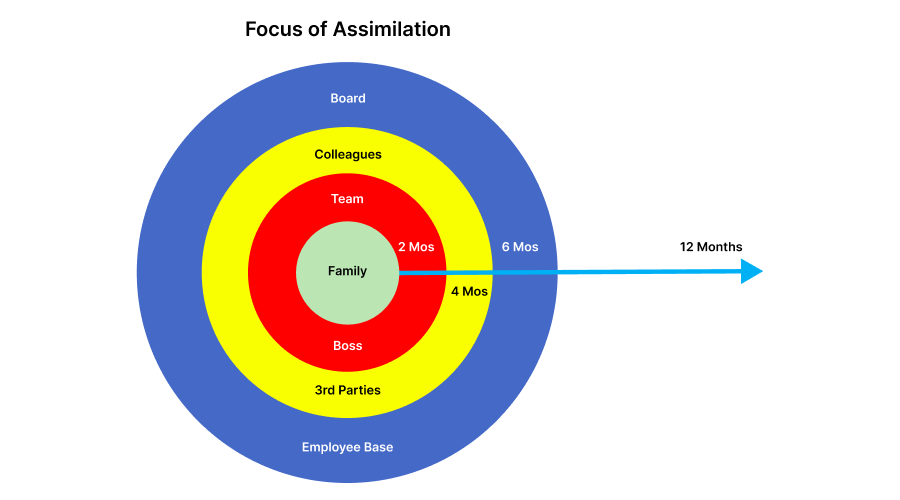
The assimilation process may differ by position. A new CEO might not have the luxury of the timing I will suggest. But for others in the C-suite or for those leading a business unit or a function, the first six months form the critical piece of onboarding, with the remainder of Year 1 filling in the gaps. Here is a graphic representation:

ARE WE THERE YET
The first couple of months have three constituencies, your family, your team and your boss. Not to say these are complete after two months. Far from it! But this is when there is a lot of heavy lifting with these key groups.

Getting things straight at home comes first, hopefully before you start the job. A position that creates turmoil for a spouse or children begins on a shaky foundation. You accepted the reassignment to Beijing without considering how your 5-year-old son will cope with his asthma? You might not be long for the job, and your company might not be too understanding about you reneging on your commitment.

I was offered a position running my company’s business in Argentina. My wife and I checked it out over a Thanksgiving weekend and came away with the belief that the culture was a bad fit for our kids. I returned to the States to tell my boss, “No, thanks.” It was the right call for the family, even if it meant closing the door on opportunities within our international business unit. Within two months I had a new position in the North American business that I could commit to, without disrupting our family life.

Having a series of conversations with your supervisor when you start is critical. Are your expectations of the job consistent with the reality you face? Can you set rules of the road in terms of communication and decision making? Often, we feel like we are expected to make an impact, when a boss still expects us to be learning. I think the real value of “quick wins” in the vernacular of Michael Watkins is, in part, to get the boss off your back temporarily, while you continue to learn. It’s probably more effective to have an open conversation with the boss about what how long they expect you might need to get up to speed before making decisions of consequence.

I’ve spoken to successful CEOs or divisional presidents who made it clear that they were going to resist imposing their will on the organization until they felt like they had a sufficient understanding of the issues, the people, the processes, etc. Their first two months on the job entailed a crash course on the market, the organizational competencies, etc. And letting others make decisions was unnerving. Leaders make decisions. Not doing so is against their nature and contrary to what they think is expected of them.

You cannot always get away with this strategy. Crises demand action, and leaders have to own that action. Sometimes there is no getting around it; you may have to act even in your ignorance.

Management involves getting things done through other people. The people you will count on the most are the ones who report to you. So, the first 2 months involve getting to know them and having them become acquainted with you. A one-day facilitated session made popular by GE three decades ago is still state of the art. It addresses these questions:
  • 1. What do we already know about the new manager?
  • 2. What don’t we know, but would like to know about our new manager?
  • 3. What are our concerns, both group and individual, about this person becoming our new manager?
  • 4. What do we want or need most from the new manager?
  • 5. What would we like the new manager to know about us, either as individuals or as a group?
  • 6. What are the major problems we think the new manager will be focusing on during the first year? (in order of importance)
  • 7. How are we going to help our new manager be successful?
Once your team is better acquainted with you, get to know them individually. How can they help you? What are their strengths? Who needs to be developed? What dynamics must you be sensitive to?

Your reports will pay much more attention to you than you will to them. They are looking for little cues from you. When you say “we,” are you talking about this team, or your former employer? What evidence do they see of you delivering on commitments? How can they determine if you have their backs? How do you demonstrate adherence to cultural values? What won’t you tolerate? This is an ongoing process, and it changes as your team changes. But this begins to gel in the first two months.

While you continue to work on relationships with family, boss and team, Months 3 and 4 add two other groups of constituents, colleagues and outside stakeholders. ​

For the first couple months, you have met your colleagues, interacted with them and tried to mind your own business. As you feel more secure in the first ring of relationships, it’s time to get more involved in the interaction with your peers. This can be in the form of building alliances through reciprocation, asking questions and finding opportunities to move from professional to personal relationships. Be aware that your ignorance can be a point of leverage, allowing you to ask naïve questions without an agenda. At the same time, your ignorance has you at a decided disadvantage in organizational politics. If your peers feel you are oblique in a way that builds your own power base, don’t be surprised to get towel-snapped. ​

With enough confidence in the critical internal relationships needed for success, many leaders begin to turn their attention outside of the organization. There may be vendors, strategic partners or customers that demand attention your attention. A sales leader whose success depends on direct relationships with customers can’t wait until Months 3-4 to focus on them. For most executives, this ring of assimilation recognizes that people who work for you own the primary 3rdparty relationships; forging external bonds comes after you make progress on the relationships with your own people.

The next ripple out brings a focus on building links to board members and on the broader employee base beyond your own team. It’s important for the organization to know who a leader is and what their priorities are. Being public about your intentions will make it easier for your team to get traction. But your team deserves that your communications have credibility. Credibility requires you to be steeped in the business and the culture. And it’s not just your credibility at stake, but the credibility of all those whom you lead. An early pronouncement that shows your ignorance hurts those you must rely upon to succeed. Don’t dig a hole for them; be judicious about what you say and when you say it.

In many businesses, board involvement is a quarterly affair. So, a C-suite leader’s first exposure to the full board may be sometime in the first ninety days. Your “rookie” label provides some insulation, assuming you avoid significant breaches in etiquette. Listen carefully, offer opinions or information when requested and don’t be afraid to admit to ignorance.

The second board meeting, sometime between Months 4 and 6, is a different matter. If you don’t have information to answer a question, it is wise to address how you will get it. If a suggestion had been made in your first exposure to the board, prepare a report on actions you’ve taken. If you decide not to act on a board member’s request, communicate that to the individual board member before the next meeting takes place. If there is bad news to report, get it out, take responsibility and provide the planned remedy. Look for opportunities to interact with board members before the second meeting. Ask for their perspectives on issues you face or introductions to their connections who may provide value.

Over Months 7-12, assimilation and relationship-building continue across all of these groups. You are able to manage greater complexity. Your familiarity with the system and with the people will allow you to assert yourself more. You can take more risks in challenging others, expanding your influence and making change happen.

As you become more comfortable in the system, you can no longer use being new as a “get out of jail free” card. A year in, questions you ask are no longer viewed as naïve. Motives might be questioned. This is when the careful groundwork of your early assimilation will pay off. Peers, supervisors, direct reports and other stakeholders have had a chance to take your measure, to learn who you are and how you add value. You no longer are given the benefit of the doubt. Instead, you have earned your place.


    Need Any Help?