
The Career Capstone

The Career Capstone

Every career has a first day, and companies plan for it carefully: recruiting, onboarding, a 90-day plan. Every career also has a last chapter, and most companies barely plan for it at all.

The question for the leader shifts from “How do I keep climbing?” to “How do I expand my impact?” to “How do I finish well?” The question for the company shifts from “Who’s next?” to “How do we hand this off without losing momentum, knowledge or people along the way?”
Why Your First Months Set the Story

Early impressions harden quickly, which is why the best transitions treat communication as part of the work, not an afterthought. Research published in Harvard Business Review by Egon Zehnder partners and Michael Watkins, summarized in Egon Zehnder’s “Onboarding Isn’t Enough”, argues that executives succeed faster when they are fully integrated into the culture, not just oriented to the role. The study reported that full integration speeds time to executive success by 40 percent on average. A new executive who explains clearly what they value and where they are heading gives the organization something to align with, which makes integration easier on everyone.

Two transitions, not one

A senior leader’s departure is two transitions running at the same time, in opposite directions.

The outgoing leader is transitioning out. They’re letting go of a role, a title and often a big part of who they are. As the handoff nears, their job changes too: less doer, more sponsor and steward. They need to pass on what they know, open their relationships to others, and get ready for a life that no longer revolves around the job.

The successor is transitioning in. They’re taking on a role whose history they don’t fully know, with relationships they haven’t built and decisions whose reasoning they weren’t there for. They need to earn credibility with a team that is still loyal to the person who hired them. And they need to create capacity, by shedding lower-value responsibilities.

The team sits in between. For a while, people don’t know whose judgment will count next. They wait, hedge and quietly delay decisions. We call that transition drag, and it is one of the most expensive and least measured costs of a leadership change.

The two transitions depend on each other. The successor can’t step fully in until the leader steps fully out, and the leader can’t step out with confidence until they trust the successor is ready.

Slow tracks, then a fast handoff

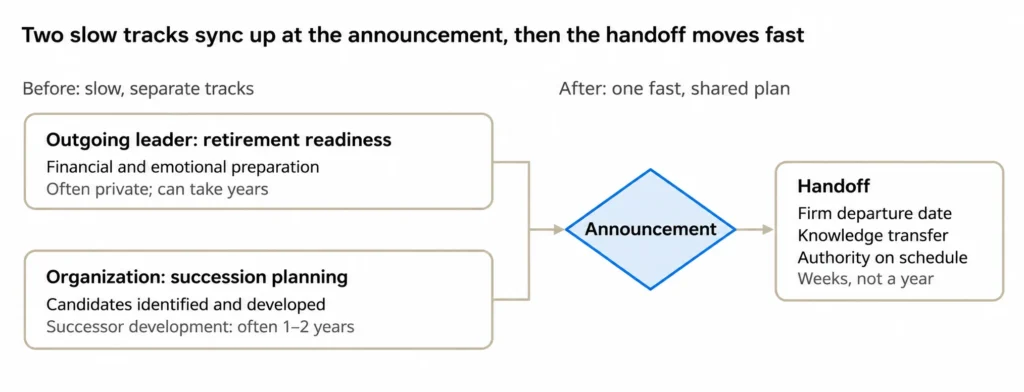
The two transitions don’t move in step. For a long time they run on separate, slower tracks:

  • Retirement readiness belongs to the outgoing leader. Someone may think about leaving for years: whether they can afford it, what they’ll do next, who they’ll be without the title. Much of this happens privately, but there are ways for the organization to provide help without creating legal risk.
  • Succession planning belongs to the organization. It identifies candidates and develops them, and a successor’s development may run for a year or two. The successor may not come from inside the organization, but starting a search to avoid a leadership vacuum should be part of a plan.
    The tracks sync up at one moment: when the leader is ready to announce their departure. From there, everything speeds up. A firm date is set, the successor is named, knowledge is handed over, and authority moves on a published schedule, over weeks rather than a year.
Two Slow Tracks to Fast Handoff

That’s why both tracks matter. If the leader hasn’t done the readiness work, they may delay the announcement or hold on after it. If the organization hasn’t done the succession work, the announcement finds no one ready to step in.

What goes wrong when only one side is planned

Most succession plans focus on the second transition: picking the successor. The first is left to chance, and the handoff between them is often improvised. The results are familiar and far more complicated than the choice of successor.

  • The long goodbye. A respected leader stays on for a year-long “victory lap.” The team keeps looking to them, and the successor never quite takes the reins.
  • The sudden exit. Plans were never discussed, so the departure comes with little notice and no handoff. Korn Ferry’s 2025 succession research found that half of CEO successions were unplanned.
  • Knowledge out the door. Deloitte reports that 92% of organizations fail to consistently capture what soon-to-retire employees know: the relationships, the judgment calls, the reasons behind past decisions.
  • A successor set up to struggle. SHRM research finds that about half of external senior hires fail within 18 months. Internal successors fare better, but only when they inherit more than an org chart.
  • A hard landing for the leader. Someone who gave decades to the company leaves without a plan for what’s next. That isn’t only a personal loss. Everyone who stays notices how the company treats its best people on the way out.

Planning both transitions together

A good capstone treats the two transitions as one connected plan. The outgoing leader gets help to finish well: deciding when and how to leave, passing on what only they know, and preparing emotionally and financially for what comes next. The successor gets help to start strong, learning why things are done before changing what is done. And the team gets clarity about who decides what, and when.

The payoff goes beyond a smooth handoff. Leaders who see a meaningful last chapter stay engaged instead of coasting. Successors inherit relationships and context, not just a title. And the organization shows everyone watching that it values its people all the way to the end.

In future posts, we’ll look more closely at each part of the capstone: how to start the conversation, how to transfer knowledge and authority and how leaders build an identity beyond the job.That’s why both tracks matter. If the leader hasn’t done the readiness work, they may delay the announcement or hold on after it. If the organization hasn’t done the succession work, the announcement finds no one ready to step in.

FAQ when tightening communication

Share a first perspective early, framed as what you have learned and what you are still exploring, then refine it. A written memo or short video at about the 100-day mark gives the organization something concrete without forcing you to claim every answer on day one.

Use both. Live sessions build trust through questions and visible listening, while video gives you a consistent, repeatable version of the message for people who cannot attend and for new hires later.

Start by naming what is worth keeping, so people do not hear your vision as a criticism of their work. Then explain clearly which behaviors you want to see more of and why, using a specific story as proof.

Listen for your own words coming back to you from others, and ask a few direct questions in skip-level meetings or pulse surveys: What do you think I stand for? What are our priorities? What has changed? If answers vary widely, simplify the story and repeat it.

    Need Any Help?