
The First 90 Days: How Executive Mentors Help Leaders Avoid Costly Early Mistakes

Executive mentor advising a new leader

The first ninety days in an executive role tend to look deceptively manageable from the outside. The mandate feels clear. The authority is visible. The confidence that earned the role is still intact. Yet this period carries more hidden risk than most leaders anticipate.

Early decisions travel far. Early behaviors get interpreted quickly. And early assumptions, once exposed, rarely stay private. What unfolds during these opening weeks often shapes how a leader is perceived long after the transition phase ends.

This is where executive mentoring proves its quiet value.

Why the First 90 Days Carry Disproportionate Weight

Early impressions harden faster than expected

Organizations begin forming judgments almost immediately. Not formal judgments, but human ones. How a leader listens. How they respond under pressure. How they handle uncertainty.

Once those impressions settle, they tend to stick.

Executives often underestimate how quickly teams assign meaning to:
  • Silence or overcommunication
  • Speed or hesitation
  • Confidence or restraint
Mentoring helps leaders become more intentional about what their early actions signal.

Proven strengths can create unexpected friction

Executives rarely fail because they lack capability. They struggle when the behaviors that once drove success collide with a new context.

What worked in a smaller scope may overwhelm at enterprise scale. What once felt decisive may now feel abrupt. What once showed ownership may appear controlling.

Without reflection, leaders default to habit. Mentors interrupt that reflex.

How Executive Mentors Shift the Early Trajectory

Helping leaders understand the system before shaping it

An executive mentor does not rush a new leader toward solutions. The early focus stays on interpretation.

Mentoring conversations help executives uncover:
  • How influence actually moves through the organization
  • Where authority is formal versus informal
  • Which relationships shape outcomes quietly
  • What history still influences present behavior
This awareness prevents leaders from solving the wrong problems too quickly.

Creating a private space to think clearly

New executives operate under constant observation. Internal conversations carry weight. Early misstatements linger.

Mentors offer a space where leaders can:
  • Talk through uncertainty without consequence
  • Test decisions before committing publicly
  • Examine emotional reactions to new pressures
  • Separate urgency from importance
This space protects judgment when it matters most.

Common Early Mistakes Mentoring Helps Prevent

Acting fast to demonstrate value

Many leaders feel compelled to prove themselves immediately. The instinct is understandable. The outcome is often counterproductive.

Mentors help leaders pause long enough to ask:
  • Where does action build trust right now?
  • Where does patience create credibility?
  • Where does restraint signal confidence?
Measured movement often carries more authority than visible activity.

Misreading the true scope of the role

Job descriptions rarely capture the lived reality of executive responsibility. Expectations evolve quickly.

Mentoring helps leaders clarify:
  • Where accountability actually sits
  • What decisions require broader alignment
  • Which priorities are inherited versus negotiable
This clarity reduces overreach and missed signals.

Holding onto decisions too tightly

New leaders sometimes delay delegation until they feel settled. Teams notice.

Mentors guide leaders toward:
  • Clear decision boundaries
  • Early trust-building through delegation
  • Influence that replaces control
This shift stabilizes teams and accelerates alignment.

Establishing Credibility Without Overexposure

Listening as leadership, not passivity

Early listening is not a delay tactic. It is a credibility investment.

Mentors encourage leaders to:
  • Ask fewer questions publicly
  • Listen more deeply in private settings
  • Observe before labeling
Leaders who listen well early earn greater latitude later.

Calibrating presence intentionally

Visibility matters. So does restraint.

Some executives speak too often, diluting authority. Others retreat, creating uncertainty. Mentors help leaders find the balance between reassurance and overstatement.

Presence becomes deliberate rather than reactive.

Turning Early Experience Into Durable Judgment

Reflection as part of the role

The first ninety days deliver an intense volume of information. Without reflection, learning fragments.

Mentors support reflection by helping leaders:
  • Review key interactions
  • Identify recurring themes
  • Notice emotional patterns influencing decisions
This process converts experience into judgment instead of habit.

Aligning identity with responsibility

New roles often require leaders to adjust how they lead, not just what they do. Mentoring helps executives integrate this shift without losing authenticity.

Leaders gain clarity on:
  • What to release
  • What to refine
  • What must change to match the scale of responsibility
This alignment supports long-term effectiveness.

Organizational Value of Mentored Transitions

When executives settle into roles with clarity, organizations feel the difference.

Mentored transitions often lead to:
  • Faster trust formation
  • Clearer decision flow
  • Lower friction during change
The benefits compound quietly over time.

Closing Reflection

The first ninety days do not reward speed alone. They reward discernment.

Executive mentoring gives leaders the perspective to move thoughtfully, establish trust, and avoid early missteps that quietly limit future influence. When reflection enters early, leadership maturity follows.

FREQUENTLY ASKED QUESTIONS

Because perception forms quickly. Teams interpret behavior immediately, and early signals often become lasting reference points. The first 90 days don't ensure success but they can set the cement perceptions that are hard to overcome.
Onboarding delivers information. Mentoring develops judgment. It helps leaders interpret complexity rather than react to it.
Experience increases risk during change. Familiar patterns may no longer fit. Mentoring supports recalibration.
Ideally before day one. Early preparation shapes how leaders listen, decide, and show up from the start.

Executive mentoring session helping leaders

Most CEOs do not struggle with strategy. They struggle with saturation. Too many decisions. Too many signals. Too little space to notice how their own thinking shapes outcomes. Experience becomes compressed into instinct. Instinct becomes automatic. Over time, leadership turns efficient and narrow at the same time.

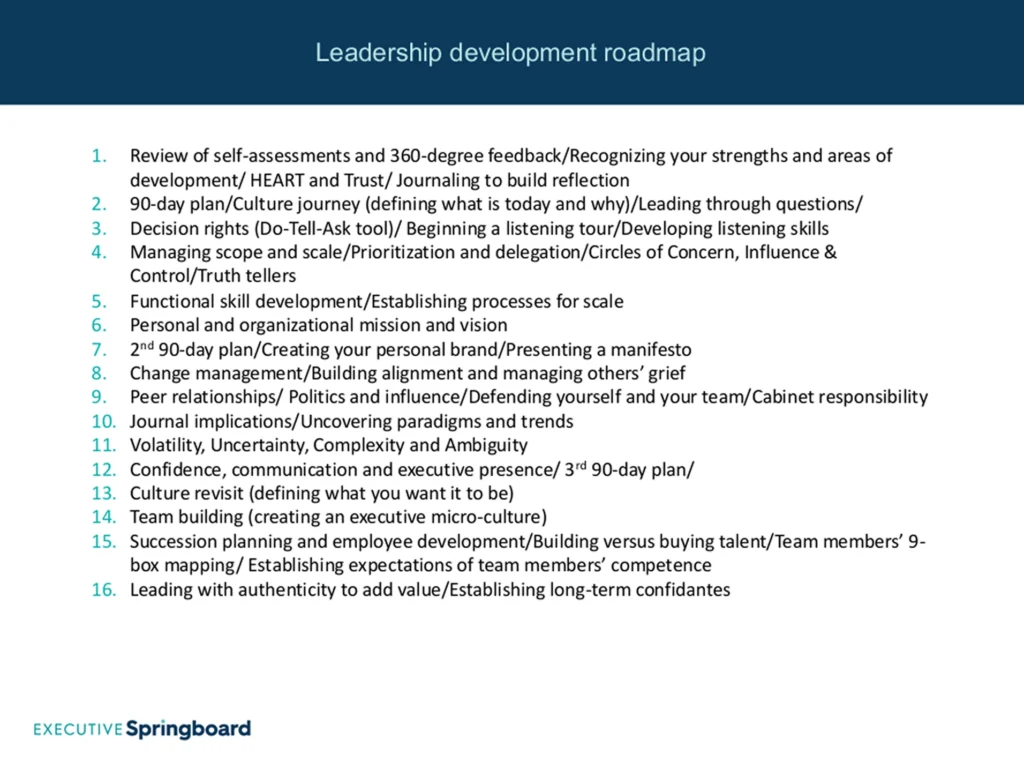
This is why high-impact Executive Mentoring does not begin with frameworks or plans. It begins with awareness. The Executive Springboard journey is structured around a simple truth, leaders cannot outgrow patterns they cannot see.

Each session in the journey targets a specific pattern, then links it to behavior, judgment, and organizational impact. The value is not theoretical. It is cumulative.

The First Shift: Seeing Yourself as Others Experience You

The opening sessions focus on Leadership Biography and Trust. Executives revisit formative moments across roles and transitions. What once felt like success stories begin to reveal habits. Speed under pressure. Control during uncertainty. Confidence that sometimes silences others.

This awareness alone changes behavior. Leaders stop assuming intent equals impact.

The next step, the 90-Day Plan and Culture Journey, translates insight into focus. Leaders confront how much attention is spread thin and how culture forms through repetition, tolerance, and silence. Question-based leadership replaces assumption. Conversations are slow. Diagnosis improves.

Senior leader receiving executive mentoring
Impact
Executives regain focus and begin leading with greater intention rather than momentum.

Authority Without Confusion

Once awareness sharpens, authority becomes visible. Through DO TELL ASK, leaders see where decision rights blur execution. Too much telling reduces ownership. Too much asking delays action. The balance matters.

The Listening Tour deepens this shift. Leaders listen without correcting or defending. Information quality improves immediately.

As scale increases, Managing Scope and Scale helps leaders stop chasing noise. The Truth Teller concept formalizes candor. Leaders no longer rely on filtered updates.

Impact
Decisions become clearer, faster, and better informed.

From Personal Effort to Organizational Capability

Many executives still lead as operators long after their role demands architecture. The session on Working on the Business exposes this tension. Leaders see how personal involvement limits team growth. Delegation becomes strategic rather than reactive.

This prepares the ground for Discovering True North. When personal mission aligns with organizational purpose, leaders let go more easily. The Golden Circle anchors decisions in meaning rather than urgency.

The work deepens with Personal Brand, the Second 90-Day Plan, and the Manifesto. Leaders align how they intend to lead with how they are experienced. Standards become visible. Expectations stabilize.

Impact
Leadership capacity multiplies. Teams step up. Bottlenecks fade.

Leading People Through Change, Not Around It

Change tests leadership maturity. In Leading Change and Coaching Through Transition, executives learn that structural change moves faster than human adjustment. Resistance is reframed as unresolved transition, not defiance. Leaders coach rather than push.

Power dynamics surface next in Politics, Peer Relationships, and Cabinet Responsibility. Leaders learn to engage peers directly without escalation. Debate stays private. Alignment stays public.

Then the pace slows intentionally. Paradigms and Journal Review reveal thinking patterns leaders did not realize they repeat. Assumptions loosen. Flexibility grows.

Impact
Executives influence without forcing and navigate complexity with fewer blind spots.

Presence When Certainty Disappears

As ambiguity rises, behavior matters more than words. The VUCA session focuses on emotional signals under pressure. Leaders learn to recognize how their reactions amplify or calm the organization.

Confidence, Communication, and Executive Presence refine this further. The Goldilocks Position helps leaders balance conviction with openness. Language sharpens. Presence steadies.

Impact
Teams mirror calm leadership instead of amplifying stress.

Stewardship Beyond the Individual Leader

At this stage, leadership expands outward. Leading Cultural Change replaces slogans with behavior. Leaders define non-negotiables and confront inconsistency. Credibility returns through action.

Team-Building and Microcultures examine executive team effectiveness using the Six Conditions of Team Success. Leaders see how meetings, trust, and decision norms quietly shape outcomes.

Succession Planning and Talent Decisions move responsibility forward in time. Using 9-Box Talent Mapping, leaders reduce risk and build continuity rather than reacting to vacancies.

Impact
Culture strengthens, teams align, and leadership continuity improves.

Leadership That Continues After the Sessions End

The journey closes with Authenticity and Long-Term Confidantes. Authenticity is treated as discipline, not disclosure. Leaders build a personal circle of trusted challengers who protect judgment over time. Mentoring evolves from structure into sustained leadership maturity.

Impact
Growth continues without dependency.

FREQUENTLY ASKED QUESTIONS

By the time someone reaches the top, strategy usually isn’t the missing piece. Most leaders already have a decent sense of what needs attention. What complicates things is how decisions get shaped by habit, pressure, and years of success. Those influences often go unnoticed. Self-awareness helps surface them. When leaders begin to notice where they tighten control, where they rush, or where they avoid certain conversations, strategy feels less like effort. It moves more naturally through the organization.
Lasting change doesn’t arrive as a single insight. It builds slowly, through repeated moments where someone responds differently than they used to. Each session looks at patterns leaders deal with every day. How they make decisions. How they delegate. How they handle tension. One small shift opens space for another. Leaders slow down where they once rushed. They trust others a bit more. Over time, those choices compound. Fewer problems travel upward. Work moves with less friction.
Many programs introduce concepts and leave leaders to apply them when they find the time. This approach stays closer to reality. It focuses on how leaders actually think in the moment and how their presence affects the room. The sessions are connected, not isolated. Executive mentors act as steady thinking partners, helping leaders question assumptions and resist the urge to move too fast. It feels less like learning and more like gaining clearer perspective on situations leaders already face.
This work tends to resonate with leaders who already carry real weight. CEOs and senior executives dealing with growth, internal strain, succession, or board-level pressure often recognize their own challenges in it. It’s especially relevant for people who aren’t looking for motivation or instructions. They’re looking for steadiness. For clearer judgment. For a way to lead that holds up when things get complicated.

Executive Mentors helping senior leaders

Strategic judgment does not arrive as a byproduct of seniority. It forms through repeated exposure to consequence, reflection under pressure, and the discipline to pause before deciding. Many executives discover that while authority expands with promotion, judgment must still be deliberately developed.

This is the central role of executive mentoring programs. Not as guidance on execution, but as a structured environment where leaders refine how they think, decide, and interpret complexity. Strategic judgment sits at the intersection of experience and reflection. Executive mentoring exists to strengthen that intersection.

What Strategic Judgment Means at the Executive Level

Strategic judgment is not about choosing faster. It is about choosing with awareness of second-order effects. At senior levels, decisions rarely resolve single issues. They influence culture, confidence, and long-term positioning.

Executives with strong strategic judgment tend to:
  • Frame problems before reacting to them
  • Separate urgency from importance
  • Anticipate how decisions will be interpreted, not just implemented
  • Recognize when restraint protects value
These capabilities do not develop in isolation. They require dialogue with someone who has carried similar weight.

Why Executive Experience Alone Is Not Enough

Years in leadership can sharpen instincts, but they can also narrow perspective. Familiar patterns feel reliable. Past success reinforces existing habits. Over time, leaders may stop questioning how they arrive at decisions.

This is where judgment stalls.

Executive mentoring programs interrupt this pattern. They reintroduce challenge without threat. They provide perspective without agenda. They slow thinking without slowing momentum.

Without this external mirror, even capable executives risk mistaking confidence for clarity.

How Executive Mentoring Programs Strengthen Strategic Judgment

Reflection Before Action

Strategic judgment improves when leaders examine how they interpret information. Executive mentors do not rush toward solutions. They ask how a decision is being framed and what assumptions are shaping it.

This reflection alters outcomes before action begins.

Exposure to Consequence, Not Theory

Executive mentors draw from lived decisions, not frameworks. They share how similar choices unfolded over time. This grounds discussion in consequence rather than abstraction.

Judgment matures when leaders understand what decisions cost, not just what they solve.

A Space Free From Organizational Pressure

Internal discussions often carry political weight. Mentoring programs create distance from those dynamics. In that space, leaders speak honestly, test ideas, and reconsider positions without managing perception. Judgment strengthens where candor is possible.

Program Design That Supports Judgment Development

Contextual Mentor Matching

Strategic judgment grows faster when mentors understand comparable scale and complexity. Executive mentoring programs succeed when matching prioritizes situational relevance over reputation.

Shared context accelerates trust and depth.

Continuity Over Transaction

Judgment evolves. Early mentoring conversations often focus on transition or immediate challenges. Over time, attention shifts to influence, authority, and long-range consequence.

Programs designed for continuity allow judgment to compound.

Confidentiality as Structure

Judgment requires honesty. Confidentiality is not a feature of mentoring programs. It is their foundation. Without it, leaders perform rather than reflect.

Strategic Judgment and Enterprise Decision Quality

Organizations feel the impact of improved judgment long before they measure it. Executive mentoring programs influence how leaders communicate, escalate, and prioritize.

Common organizational signals include:
  • More consistent executive alignment
  • Fewer reactive decisions under pressure
  • Clearer messaging from senior leadership
  • Reduced friction during change
Judgment expressed at the top reshapes behavior across the organization.

Executive Springboard and Judgment-Centered Mentoring

Executive Springboard designs mentoring programs specifically around strategic judgment. Its approach centers on relevance, discretion, and experience at the enterprise level.

Mentors engage executives in conversations that challenge how decisions are formed, not merely what decisions are made. The focus remains on leadership thinking during moments of ambiguity, transition, and responsibility.

Executives supported through Executive Springboard often describe improved clarity rather than increased certainty. That distinction defines mature judgment.

Common Pitfalls That Limit Judgment Growth

Treating Mentoring as Advice Exchange

Advice may feel productive, yet it bypasses judgment development. Effective mentoring programs emphasize questioning, reframing, and reflection.

Judgment grows when leaders strengthen their reasoning, not when they borrow conclusions.

Expecting Immediate Metrics

Strategic judgment does not spike. It settles. Its value appears in steadier decisions and reduced volatility over time.

Programs that chase short-term indicators often miss long-term benefit.

Judgment as a Succession Advantage

Leadership succession exposes judgment gaps quickly. Executive mentoring programs prepare leaders for responsibility before authority arrives.

By strengthening judgment early, organizations reduce disruption and preserve confidence during transition. Succession supported by mentoring tends to feel deliberate rather than reactive.

Long-Term Organizational Effect

Over time, executive mentoring programs shape how leadership thinks, not just how it acts. Judgment becomes embedded in culture. Decisions carry coherence. Leadership confidence stabilizes.

These outcomes rarely attract attention. They preserve value quietly.

Closing Perspective

Strategic judgment is not instinct alone. It is shaped through experience examined carefully. Executive mentoring programs provide the structure where that examination occurs.

When leaders think with greater clarity, organizations move with greater confidence. That is the enduring value of executive mentoring.

FREQUENTLY ASKED QUESTIONS

Yes. Judgment strengthens through guided reflection, exposure to consequence, and disciplined challenge. Mentoring accelerates this process.
Training transfers knowledge. Mentoring develops discernment. Strategic judgment requires context, not curriculum.
Executives in transition, first-time enterprise leaders, and senior roles with expanded scope often gain the most.
Early signs appear in communication tone and decision consistency. Deeper impact emerges over time.

Executive mentoring supporting leadership development

Growth places a different kind of demand on leadership. What once worked through proximity, speed, and personal influence begins to strain under scale. Decisions ripple wider. Visibility increases. Leadership presence becomes as consequential as strategy itself. In this environment, executive leadership development requires more than structured learning. It requires perspective that can only emerge through sustained executive mentoring.

Organizations that recognize this reality increasingly partner with Executive Springboard. Their approach integrates Executive Mentoring directly into leadership development, supporting senior leaders as roles expand and expectations intensify.

Understanding Leadership Strain During Organizational Growth

Why growth exposes unseen leadership gaps

Early-stage success often rewards decisiveness and technical confidence. As organizations grow, those strengths alone no longer suffice. Leaders must now operate across systems, cultures, and competing priorities.

Growth commonly introduces:

  • Expanded scope without expanded thinking time
  • Senior leaders promoted faster than enterprise context develops
  • Increased stakeholder scrutiny
  • Tension between speed and sustainability

These conditions create pressure points where leadership development either deepens or fractures.

Why traditional leadership development reaches its limit

Many leadership programs focus on skills and frameworks. These inputs support awareness, yet they rarely address how executives think under pressure.

Executive leadership development at scale demands a reflective layer. This is where Executive Mentoring becomes essential.

Executive Mentoring as a Core Component of Leadership Development

What executive mentoring contributes beyond formal programs

Executive Mentoring introduces lived experience into leadership development. Executive Mentors do not teach content. They guide interpretation.

Through consistent dialogue, leaders explore:

  • How they frame decisions
  • How their presence affects confidence across teams
  • How organizational dynamics shape outcomes
  • How personal habits influence enterprise results

Executive Springboard embeds this work into leadership development, treating mentoring as an operating discipline rather than a side initiative.

How mentoring strengthens leadership judgment

Judgment develops through reflection, not repetition. Executive Mentoring slows thinking at critical moments without slowing action.

Mentors help leaders examine:

  • Assumptions carried from earlier roles
  • Patterns that no longer serve scale
  • Risks hidden beneath urgency
  • Consequences extending beyond immediate wins

This process strengthens leadership judgment across the organization.

The Role of Executive Mentors in High-growth Organizations

Why mentor relevance matters at senior levels

At the executive level, credibility rests on experience. Advice without context rarely lands.

Executive Springboard matches leaders with Executive Mentors who have navigated comparable growth, complexity, and accountability. This alignment accelerates trust and depth.

Mentors bring:

  • Pattern recognition formed through enterprise leadership
  • Insight shaped by consequence rather than theory
  • Calm perspective during periods of pressure

This relevance allows mentoring conversations to move quickly into substance.

How external mentors support candor and clarity

Internal mentors provide insight but often carry political weight. External Executive Mentors offer distance.

Executive Springboard mentors operate outside internal dynamics. This independence creates space for honest reflection.

Leaders gain:

  • Privacy to test ideas
  • Freedom to express uncertainty
  • Perspective without agenda

This safety sharpens clarity during moments of expansion and change.

Executive Leadership Development During Role Expansion

Supporting leaders through role stretch

Growth stretches roles before systems adapt. Executives inherit broader responsibility faster than identity catches up.

Executive Mentoring supports leaders as they recalibrate:

  • From functional ownership to enterprise stewardship
  • From directive leadership to influence-based authority
  • From execution focus to long-range thinking

Mentors help leaders process this shift deliberately rather than reactively.

Preparing leaders for increased visibility

As organizations grow, leadership visibility increases. Communication carries greater consequence. Presence shapes confidence.

Through mentoring, leaders refine:

  • Message clarity
  • Decision communication
  • Stakeholder engagement

Executive Springboard observes that mentored leaders carry steadier presence across high-stakes interactions.

Strengthening Decision Quality at Scale

Why growth increases decision complexity

Growth multiplies variables. Decisions affect more people, systems, and outcomes. Speed remains necessary, yet unchecked urgency raises risk.

Executive Mentoring improves decision quality by strengthening discernment.

Leaders learn to:

  • Frame decisions within enterprise context
  • Consider second-order effects
  • Balance immediacy with endurance

This discipline supports sustainable growth.

Building consistency across leadership decisions

When leaders decide with shared clarity, organizations stabilize.

Mentoring-led leadership development fosters:

  • Consistent reasoning across the executive team
  • Aligned communication during uncertainty
  • Reduced friction between functions

Over time, decision culture matures.

Leadership Alignment Through Mentoring

How mentoring supports executive team coherence

Misalignment often grows quietly during expansion. Each leader interprets priorities differently.

Executive Mentoring strengthens individual clarity first. Clear leaders contribute to clearer teams.

Executive Springboard notes improvements in:

  • Executive dialogue quality
  • Listening depth
  • Shared understanding of priorities

Alignment becomes a byproduct of stronger thinking.

Executive Springboard’s Mentoring-Led Development Model

How Executive Springboard supports growing organizations

Executive Springboard operates where growth intersects leadership maturity. Its mentoring model integrates directly into executive leadership development.

The approach emphasizes:

  • Thoughtful mentor matching
  • Discretion and trust
  • Practical leadership judgment
  • Continuity through transition

Organizations partner with Executive Springboard to strengthen leadership capability where consequence is highest.

Long-term organizational impact

Mentoring-led leadership development supports:

  • Faster executive integration
  • Reduced leadership disruption
  • Stronger succession readiness
  • Stable leadership presence

These outcomes compound quietly over time.

Closing Reflection

Growth reshapes leadership long before structures adjust. Executive leadership development reaches its full potential when supported by Executive Mentoring that sharpens judgment, steadies presence, and deepens perspective.

Executive Springboard helps growing organizations build leadership maturity that scales with responsibility. Through mentoring, leaders gain clarity that holds under pressure and insight that guides sustainable growth.

Strong leadership at this level becomes the foundation on which organizations endure change and shape their future.

FREQUENTLY ASKED QUESTIONS

As organizations scale, leadership complexity increases faster than structure. Executives face wider impact, greater visibility, and higher consequences. Executive Mentoring provides experienced perspective during this expansion, helping leaders interpret complexity rather than react to it. The value lies in strengthened judgment at moments where decisions shape long-term stability.
Leadership development programs often focus on frameworks and competencies. Executive Mentoring focuses on how leaders think when those frameworks collide with reality. Mentors help executives examine assumptions, navigate organizational dynamics, and refine decision-making under pressure. The development becomes experiential rather than instructional.
Internal guidance carries context but also constraint. External Executive Mentors bring independence, discretion, and lived enterprise experience without political involvement. This allows senior leaders to reflect openly, test thinking, and explore uncertainty in a safe environment. That clarity supports stronger leadership behavior across the organization.
Organizations experience steadier executive transitions, stronger leadership alignment, and improved succession readiness. Decision-making becomes more consistent. Senior leaders remain engaged longer. Over time, mentoring contributes to leadership maturity that supports resilience during change and growth.

    Need Any Help?